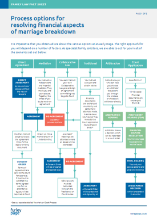
Process options for resolving financial aspects of marriage breakdown
It is important to obtain advice about the various options at an early stage
A divorce solicitor is a specialist family lawyer who provides expert guidance through every stage of separation and divorce. They explain your legal options, prepare and manage all required paperwork, negotiate fair agreements on finances, property, and child arrangements. They will represent you throughout the process to protect your rights and achieve the best possible outcome for you and your family.
All members of the Family Law Team at Furley Page are specialist divorce lawyers recognised across Kent, Canterbury, Whitstable, Medway and the South East, and are well regarded in their field by clients and other professionals for providing practical, compassionate and solutions-led divorce advice.
If you are considering divorce proceedings, our specialist family law solicitors can answer the many questions you will undoubtedly have. They will clearly explain what you can expect and how each step of the divorce process will work, providing comprehensive support across all core areas of divorce and separation, including:
We not only support you with clear, practical legal advice, but also with the wider challenges that often arise during divorce. Our divorce lawyers can support you through the emotional and practical problems you may face. Where appropriate, our family law team will assist you in securing services of other professionals who can help with non-legal issues that you or your family might also need to resolve at this difficult time.
We have access to a network of other professionals both through our extensive in-house legal sectors and also the plethora of local connections built up by our specialist divorce solicitor team through years of working in Kent and Medway and across the South East.
For many couples who go through the unsettling period of separation or divorce, their primary goal will be to achieve future financial certainty. Our specialist divorce solicitors will guide you through the process as to how that can be achieved, and will advise you on how your future financial situation may look.
The starting point is for there to be full financial disclosure so a clear understanding is gained about the assets, income and liabilities that are to be considered so advice can be provided on a fair distribution of those assets.
In the majority of cases, the parties agree a financial settlement without either of them issuing an application to the Court, using assistance from solicitors. Rayma Collins, Partner and Head of our Family Law team, or our qualified mediator and Partner Naomi Hayward can discuss with you non-Court dispute options to include mediation and collaborative law.
Even where a Court application has to be issued, most cases are resolved by subsequent agreement between the parties with the aid of lawyer led negotiations.
Process options for resolving financial aspects of marriage breakdown
It is important to obtain advice about the various options at an early stage
Divorce, as with any other significant event, is a time to reflect on wishes that have been made in a will or, to make a will to ensure your wishes are accurately recorded. This is something our specialist solicitors will discuss with you. The ownership of property, usually the largest asset a couple owns, will also be discussed and we will advise you if action should be taken to protect property interests now, or in the event of death before a divorce is concluded.
You may be initiating a divorce, responding to a divorce application, or need advice for an issue that has arisen in an ongoing case. Whatever your circumstances, our experienced family lawyers can make a vital difference to the outcome.
We support a wide range of clients, including:
We offer constructive non-dispute resolution options that include:
Whichever option you choose we will resolve your dispute with the best interests of your family as the focus.
Each above non-Court method is an alternative to the traditional court-based divorce with a focus on fairness and mutually agreed and lasting outcomes, avoiding the costs and delays attributed with the standard court process.
Please note that we do not offer a Legal Aid service.
With the right legal adviser on your side, divorce does not need to be unnecessarily distressing.
We will be here to listen to all of your concerns and will guide you through the process to make it as pain free as possible. At the first meeting (which can be in person, by telephone or virtually) we will discuss your situation and specific needs before advising on which process option is the right one for you.
Call us on
0333 331 9877Call us on
0333 331 9877
©Furley Page LLP 2025